Setting Up SDR
Supported Radios
SkyRoof uses the Soapy SDR engine to interface with the SDR radios. The drivers for the following radios are included in the SkyRoof setup:
- Airspy;
- AirspyHF+;
- SDRplay;
- RTL-SDR;
- HackRF;
- LimeSDR;
Radios that are not on this list can also be used, see Adding Support of Other Radios below.
Installing The Drivers
Most of the SDR devices require the driver to be installed before you can start using them. Check the manufacturer's web site, or search on Google, for the driver installation instructions. At the time of this writing, the following instructions were available on the Web: Airspy, RTL-SDR, SDRplay, HackRF, PlutoSDR, LimeSDR.
Once you install the drivers and make your radio work with its native software, proceed to the next step.
Note
The LimeSuite driver included in SkyRoof reaches the radio through libusb, not through the CyUSB and FTDI drivers that the LimeSuite installer sets up. If SkyRoof does not see your LimeSDR while other software does, bind the device to the WinUSB driver with Zadig, selecting your Lime device in its device list.
Adding Support of Other Radios
SkyRoof can work with any SDR that has a SoapySDR driver module, even if the module does not come with SkyRoof. To add such a radio:
obtain the SoapySDR driver module for your radio. Pre-built modules for Windows are included in PothosSDR, where they are located in the
lib\SoapySDR\modules0.8folder. The complete list of the SoapySDR drivers, with links to their source code, is available on the SoapySDR wiki. The module must be a 64-bit build for the SoapySDR ABI version 0.8;copy the module dll, and any dlls that it depends on, to the
lib\SoapySDR\modules0.8folder of the SkyRoof installation, usuallyC:\Program Files\Afreet\SkyRoof\lib\SoapySDR\modules0.8;install the manufacturer's driver for the radio as described in the previous section;
restart SkyRoof and open the SDR Devices dialog. The radio should appear in the list of devices.
Note
Some driver modules interfere with the detection of other SDR devices. The PlutoSDR module is one such
example, and for this reason it is no longer included in the SkyRoof setup. If your radios are no longer
detected after you add a new module, delete that module from the modules0.8 folder.
Selecting an SDR device
Connect your SDR device to the computer, then click on Tools / SDR Devices in the main menu. This will open the SDR Devices dialog:
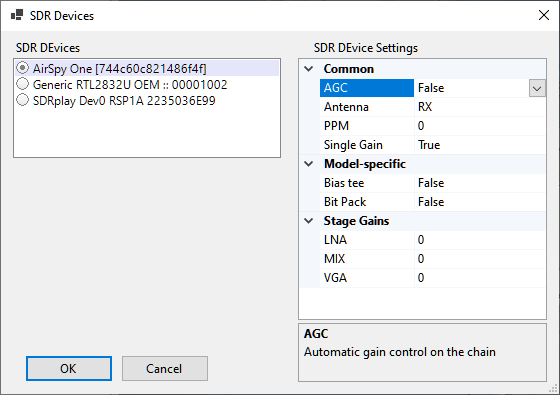
All active SDR devices are listed on the left panel. Click on the one that you want to use.
Configuring the device
The right panel shows all settings that the device driver understands. The setting names and descriptions (shown on the bottom panel) come from the driver, with two exceptions described below. For information about these settings see the documentation that comes with the radio.
The two settings, common to all radios, are:
PPM - the correction factor for the SDR clock frequency, expressed in parts per million. This setting is important for the correct operation of the Doppler tracking algorithm, see the Calibrating PPM Correction section for details;
Single Gain - when set to true (and AGC is off), the SDR gain is controlled by the RF Gain slider on the toolbar. This is the recommended setting. When it is set to false, the settings in the Stage Gains are applied to the individual stages of the SDR, and the gain slider is disabled.
Using an SDR with a Transverter
If you connect your SDR to the IF output of a VHF/UHF transverter (so the SDR is tuned to 28–30 MHz while it actually receives 144/432 MHz signals), enable the SDR Offset in the Transverter section of the Settings. SkyRoof will tune the SDR to the IF band while the waterfall scale and the frequency display continue to show the actual satellite RF. See Setting Up Transverter.
Using Remote SDR
SkyRoof can use SDR devices connected to a remote (or local) computer via the SoapyRemote driver. To enable remote access to SDR:
On the remote computer:
install SoapySDR which is available as part of PothosSDR;
run the remote server that comes with SoapySDR:
SoapySDRServer.exe --bind
In SkyRoof:
enable SoapyRemote in the Settings dialog;
enter the host name of the remote computer, or leave "localhost" if the radio is on the same computer.
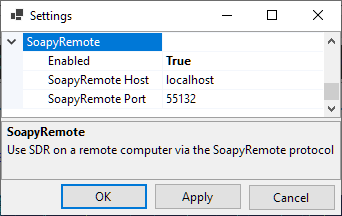
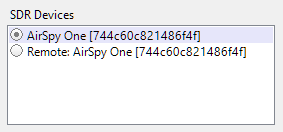
Open the SDR Devices dialog and select the remote SDR device from the list. If the device and remote server are on the localhost, you will have a choice between a direct connection to the radio and a connection via the server.